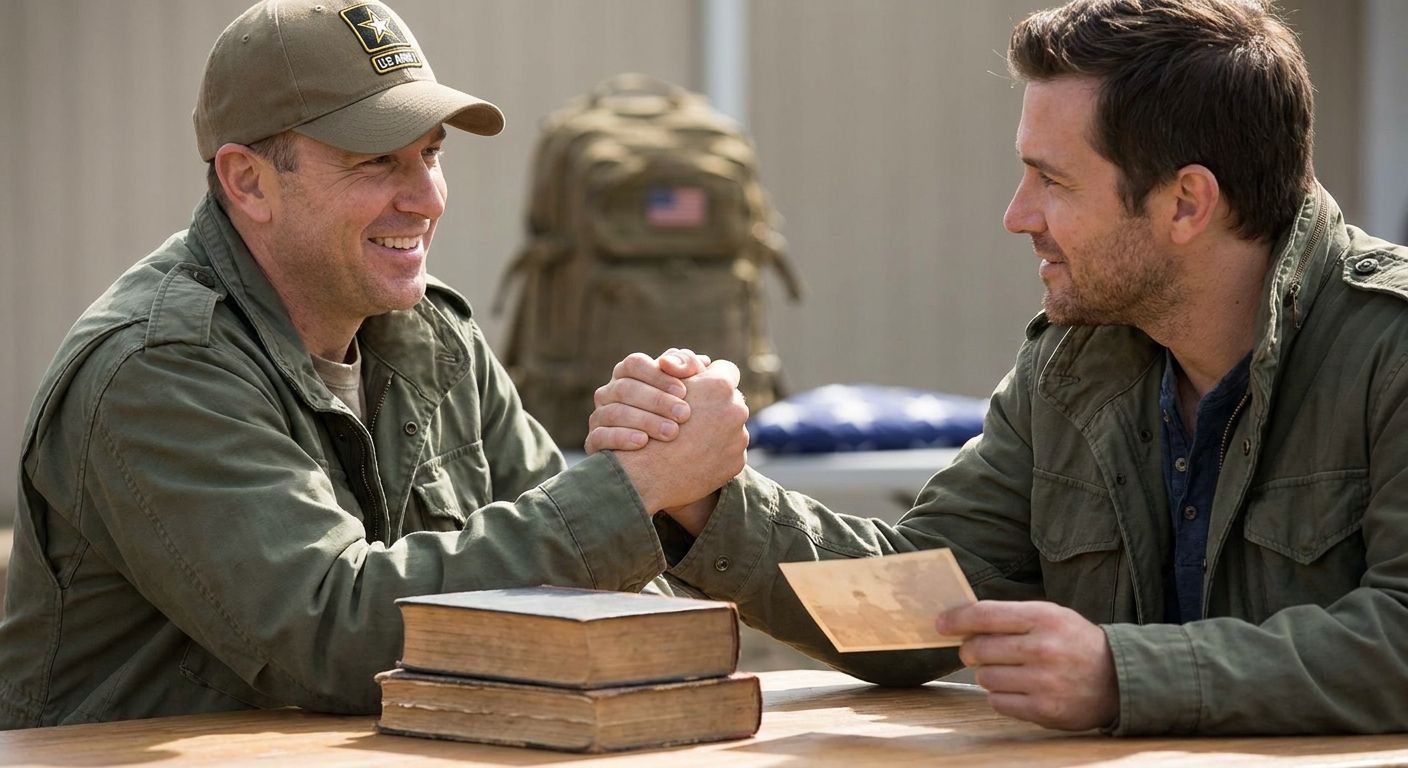
Second chance military gay romance pairs deployment-era heartbreak with a reunion arc, built for readers who want reconciliation to feel earned, not convenient. The military setting raises the stakes on the breakup itself — deployment, injury, rank, or an old cover-up usually did the damage, so the reunion has to clear a bigger hurdle than a normal contemporary romance would ask for.
- Military gay romance second chance works best when the break-up cause (deployment, injury, secrecy) gets fully resolved before the reunion, not glossed over.
- Dual-timeline structure is the most common format in 2026 releases tagged second chance military M/M.
- Heat level and content-warning checks matter more here than in most subgenres because PTSD and combat injury show up often.
- Trope-tagged review browsing beats blind Goodreads searching for finding vetted military gay romance second chance picks.
Why military gay romance matters for second chance readers
The second chance trope depends on distance — physical, emotional, or both — and military service manufactures that distance without any authorial contrivance. Deployment schedules separate couples for realistic stretches of time, rank and chain-of-command create believable reasons why two men couldn't just talk it out, and combat injury or PTSD gives the reunion arc actual emotional work to do instead of a flimsy misunderstanding plot.
Readers drawn to this pairing tend to want the angst to be structural, not manufactured for page count. If you're building a reading list, start by browsing historical gay romance books too — a good chunk of military-set second chance stories lean historical, especially anything set around Vietnam-era or Gulf War timelines, and the tonal overlap is heavy.
What makes this segment different from general M/M second chance
- The break-up cause is external and time-bound (a deployment ends, an injury heals, a discharge date arrives) rather than a personality flaw that has to be "fixed"
- Rank and command structure can add a power-imbalance layer on top of the romance
- PTSD, survivor's guilt, and traumatic injury show up as real plot content, not backdrop
- Reunions often hinge on one character finally being honest about what happened during separation, not just apologizing for leaving
Steps to build a military gay romance second chance reading list
Nail down which tropes you actually want
"Second chance" and "military" both cover a lot of ground. Before you start pulling books, decide which combination you're after:
- Same-unit reunion (they served together, then lost contact)
- Hometown-sweetheart-turned-soldier (one left for service, one stayed behind)
- Injury-triggered separation (one partner pushes the other away after getting hurt)
- Secret-relationship-blown-open (don't-ask-don't-tell era stories, closeted rank issues)
- Post-discharge reunion (both are civilians again, old wounds resurface)
Check the timeline structure before you buy
Most military second chance M/M books run one of two structures, and knowing which one you're getting changes how the angst lands.
- Dual timeline: chapters alternate between the original relationship and the present-day reunion
- Linear present-day only: backstory comes through dialogue and flashback, reunion happens in real time
- Epilogue-heavy: the bulk of the book is the separation, reunion is compressed into the last act
- Series-spanning: the "second chance" doesn't resolve until book two or three of a series
Screen for heat level and content warnings
This is the step readers skip most and regret most. Military settings pull in combat trauma, injury, and sometimes on-page violence alongside the romance, so a quick check saves you from a book that doesn't match your tolerance.
- Confirm whether PTSD or flashbacks are depicted on-page versus referenced
- Check if the injury (amputation, burn, TBI) is a plot point or just mentioned once
- Look for explicit heat-level tags — closed-door, low, medium, or high — before committing
- Search the title plus "content warning" or "trigger warning" if the retailer listing doesn't say
- Note whether infidelity caused the original break-up; that's a hard line for a lot of second chance readers
Verify the military details before you commit
Readers in this segment notice sloppy research fast, and it kills the reunion payoff if the setup feels fake.
- Rank progression should track logically with the character's years of service
- Deployment length and rotation should match the branch depicted (Army, Marines, Navy, Air Force timelines differ)
- Medical discharge and VA benefit details, if mentioned, should read as researched rather than guessed
- Don't-ask-don't-tell references should match the actual repeal timeline (2011) if the book is set in that era
Track series order and companion reads
Military romance leans series-heavy because deployment cycles and unit rosters give authors a built-in cast for spin-offs.
- Confirm whether the second chance couple is the main pairing or a secondary couple from an earlier book
- Check if the reunion resolves within one book or stretches across a duology
- Look for companion novellas that fill the separation-era gap between the couple's first and second chance
- Note publisher and release date so you're not accidentally starting mid-series
Use trope-tagged review browsing instead of blind searching
Once you know your tropes, heat level, and timeline preference, the fastest way to fill a list isn't scrolling Goodreads shelves that reader-tag inconsistently. A review site organized by trope, heat level, and content warning gets you to a shortlist faster than keyword searching a retailer.
- Filter by "military," "second chance," and heat level together instead of one tag at a time
- Read the CW section of a review before the plot summary if trauma content is a dealbreaker
- Cross-reference author backlist once you find one book that fits — military romance authors tend to write in the space repeatedly
- Check publication date to prioritize 2026 releases if you want current titles over backlist
Build a rotating to-be-read list
Don't just save titles — sort them by the trope combination and timeline structure you identified in step one, so you're not rereading the same reunion beat five times in a row.
- Group by separation cause (deployment, injury, secrecy, discharge)
- Group by timeline structure (dual, linear, epilogue-heavy, series-spanning)
- Flag heat level so you're not surprised mid-chapter
- Note series position to avoid starting on book three
Browse trope-tagged M/M reviews
Filter by heat level and content warning before you buy.
Ways to find military gay romance second chance reads
| Option | Best for | Key limitation |
|---|---|---|
| Trope-tagged review browsing | Readers who want heat level and CW confirmed before buying | Coverage depends on what's already been reviewed |
| Goodreads shelf search | Broad discovery across self-published and traditional titles | Reader-submitted tags are inconsistent |
| Author backlist reading | Fans who found one author's military catalog they trust | Limited variety within a single author's voice |
| Publisher new-release lists | Staying current on 2026 titles | Mixes subgenres, needs manual filtering |
Verdict: trope-tagged review browsing wins for accuracy on heat level and content warnings; Goodreads wins for raw volume of titles. Use both — narrow with tags, then confirm with a review before buying.
Common mistakes second chance readers make with military romance
- Assuming "second chance" means low angst. The military setting usually raises the stakes, not lowers them — expect real conflict before the reunion pays off.
- Skipping the PTSD and injury content warning. This subgenre depicts combat trauma more than most M/M categories; check before you're mid-chapter.
- Ignoring series reading order. Military romance spins off secondary couples constantly; starting mid-series spoils the first couple's arc.
- Judging heat level by the cover alone. Military covers trend toward similar aesthetics regardless of whether the book is closed-door or explicit.
- Not checking the era for don't-ask-don't-tell accuracy. Books set before 2011 that ignore the policy entirely usually signal thin research elsewhere too.
“The reunion only lands if the reason they split actually gets resolved on the page, not just apologized for in one line.”
FAQ
What is military gay romance second chance as a subgenre?
It's M/M romance where a couple separated by deployment, injury, rank, or secrecy reunites and rebuilds trust. The military setting supplies the reason for the original break-up, and the second chance arc resolves it.
Is second chance military gay romance always high angst?
Not always, but most entries in the subgenre run medium to high angst because the separation cause (combat, injury, closeted rank issues) is inherently heavy. Closed-door and lower-angst options exist but are less common than dual-timeline dramatic ones.
Does military gay romance second chance require reading a series in order?
Only when the couple is a secondary pairing introduced in an earlier book. Standalone second chance military romances don't require series order, but companion novellas often fill in separation-era backstory.
How do I check content warnings before buying a military gay romance book?
Search the title plus "content warning" if the retailer listing doesn't specify, or use a review site that lists CWs alongside heat level. PTSD, combat injury, and infidelity are the three most common flags in this subgenre.
What's the difference between dual-timeline and linear second chance structure?
Dual-timeline alternates chapters between the original relationship and the present-day reunion, showing both eras directly. Linear structure stays in the present and reveals the backstory through dialogue and flashback instead.
Are don't-ask-don't-tell era stories still being published in 2026?
Yes, historical-set military M/M romance referencing the pre-2011 policy is still a common setting choice for second chance plots, since the policy created a built-in reason for secrecy and separation.
Where do I find military gay romance second chance recommendations with heat level listed?
Trope-tagged review sites that list heat level and content warnings alongside the plot summary get you a vetted shortlist faster than a general retailer search.
One last thing
The books that stick in this subgenre almost never resolve the reunion in a single conversation — the ones readers reread put a full chapter or more between "we're talking again" and "we're actually okay," because trust after a military-caused separation doesn't rebuild on one apology. If a synopsis promises reconciliation in the first act, check the page count against the series position before you buy; it's usually a sign the real second chance arc is book two.